

I grew up going to Quaker Meeting and went to a Quaker school, and I’ve always found it surprising how little they appear in the American story of commerce, entrepreneurship, and honest hard work, given their contributions.
Reading Will Manidis and Nabeel Qureshi's essay on moral formation versus moral signaling in commerce reminded me of their significance.

Will and Nabeel’s essay traces the Quaker spirit through the English Industrial Revolution, and it surfaces something most economic histories miss. The Quakers didn’t succeed because they were honest and hardworking; plenty of people are honest and hardworking. They succeeded because their honesty was structurally enforced. Community accountability, real consequences for fraud, and constraints that couldn’t be renegotiated the moment they became costly. The results included the introduction of fixed pricing and fair dealing. Economic levers that worked because the people wielding them believed the constraints were received from God rather than chosen for advantage.
As Jony Ive shared of the Quaker’s ethos: “Work as though you are being watched by God and for the good of mankind.”


There’s an American chapter of the same story that deserves telling, because it may be the earliest example of something we’ve taken for granted in Silicon Valley and shows signs of breaking.
In the late 1780s, Moses Brown, a Rhode Island merchant and Quaker convert, became obsessed with a specific technology problem. England had industrialized cotton spinning and made it illegal to export the machinery or even the plans for it. Brown believed that whoever brought that capability to American soil would reshape the economy. He funded a series of attempts to create similar technology with local mechanics, burning capital on conviction long before he had any proof it would pay off. Every single one failed.
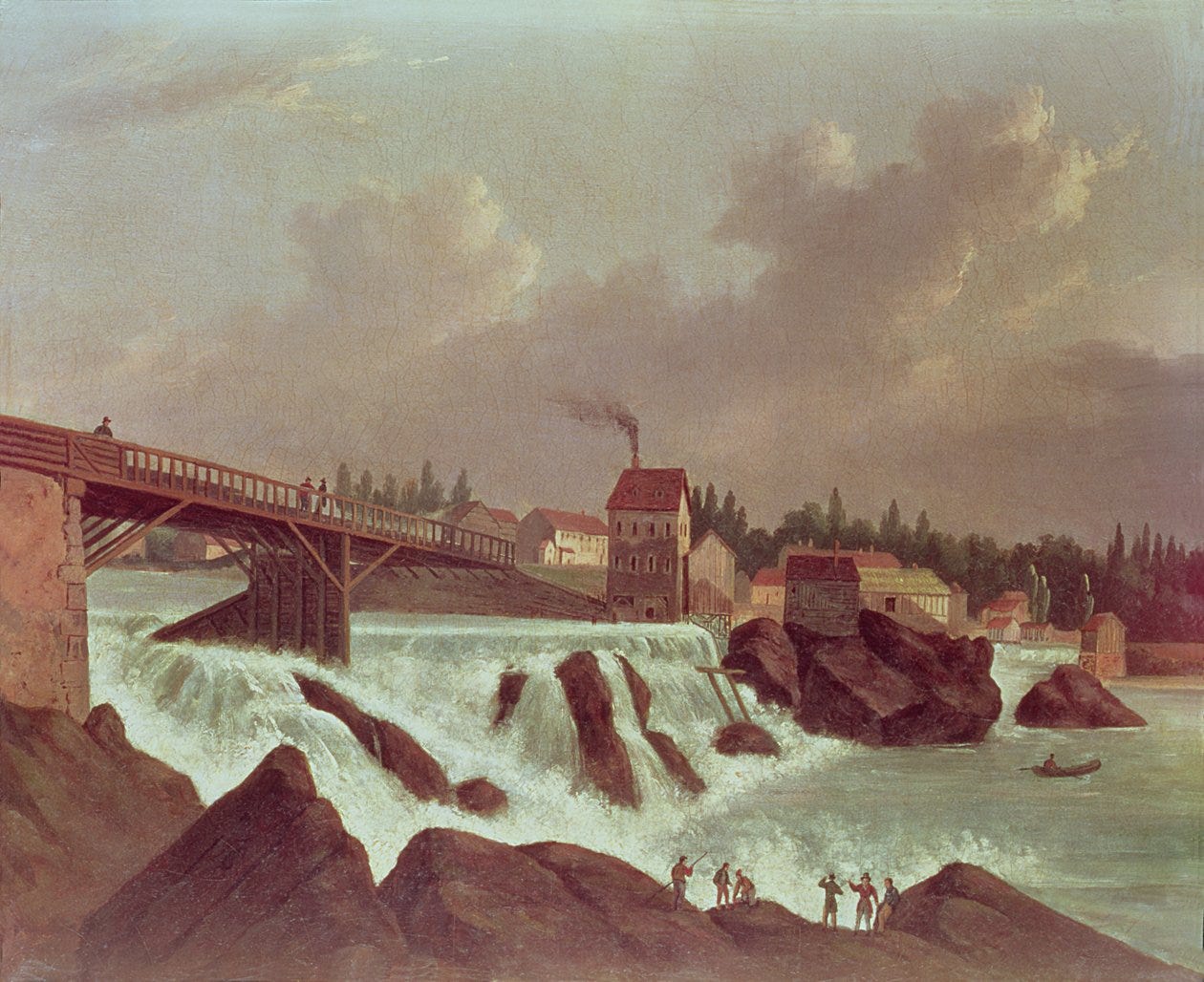
Then, in 1789, he found Samuel Slater. Slater was a 21-year-old English apprentice who had memorized the design of a British water frame and had recently emigrated to America with nothing but the plans in his head. Brown brought him to Pawtucket and backed him. He provided the capital, the workspace, the raw materials, and the network of merchants who would take whatever Slater could produce to market. By the early 1790s, they had built what became Slater Mill in Pawtucket, widely regarded as the first successful water-powered cotton mill in America and the seed from which New England’s entire industrial system grew. President Jackson visited the mill 30 years later, recognizing Slater as “father of the American manufactures.” You can still visit the mill today. I took several field trips there as a kid.
Brown was, in the plainest sense, a seed investor — arguably among the first on American soil. He identified a strategic gap, sourced a founder with unique and irreplaceable knowledge, bankrolled repeated failure until the technology worked, and then provided the commercial infrastructure to scale it. The pattern is indistinguishable from what the best early-stage firms do today.
But then, as now, the capital was the easy part. What made it possible was a web of trust and mutual obligation dense enough that two people who barely knew each other could bet their livelihoods on a handshake. Famously, Brown’s entire underwriting process was a letter, an apprenticeship paper, and a conversation in a mid-winter sleigh ride to Pawtucket. The partnership terms he offered gave half the business to a young immigrant whose only collateral was a promise and a memory. Slater reportedly told Brown: if he couldn’t produce yarn as good as England’s, he’d take nothing for his services and throw the whole attempt over the bridge. Brown took him at his word. The contract was already written in something older and more binding — a shared understanding that the work was meaningful, that the constraints were not negotiable, and that the community underwriting the deal would hold both parties accountable through ups and downs. The Quaker method.
This carried forward hundreds of years and, while not directly, underpins the structure that made Silicon Valley work for decades — one I, and countless others, have benefited from directly. Optimistic people taking bets on creativity and ambition, deploying high-risk capital into technology ventures where the investors have little control. That method only functions when the trust is real, and the interconnecting bonds are meaningful.
Lately, there’s a growing sense that those bonds are thinning. Nikunj Kothari wrote about this recently: https://substack.com/home/post/p-186363614
More transactional, weaker loyalties, and in some cases even public fraud and lying from supposed leaders in the market. Funds invest in competitors because they “can’t afford not to.” Co-founders boomerang between hyperfunded startups chasing higher equity packages right when the vesting cliff is reached. Founders do YC angling for an acquihire before they’ve shipped anything.
None of it is necessarily irrational in isolation. But collectively, it hollows out the thing that made the system work in the first place: the belief that the people on the other side of the table meant what they said and would still mean it when conditions changed.
The trust and relationship bond isn’t dead, but it’s scarcer, which makes it more valuable, not less.
The Quakers, who call themselves the Society of Friends, had community and God to drive discipline. Silicon Valley had tight networks and visible reputational accountability. Neither scales to a world of global capital and media. We can’t recreate the structural enforcement that made Moses Brown and Samuel Slater’s handshake last. The void is real.
But some bonds still hold. Like the Society of Friends, they operate on principles and accountability for one’s actions. The work itself is the moral act: make good products with good people, pay fairly, tell the truth even if it costs you. The firms and founders operating this way won’t necessarily outperform in the next cycle. But they’ll outperform over the twenty-year arc where trust compounds while transactional players burn capital on lawyers and optionality.
This requires the same thing it required in Pawtucket. Not virtue as signaling or a moral high ground. But rather a higher calling to act on principle and absorb the cost that comes with it. Those people will find each other, and what they build will outlast the cycles.
As the world inevitably becomes more transactional, I don’t know if this is true, but it’s certainly the game worth playing.