

The Real Thing
“Be real”
That’s the advice right now. Be authentic. Be human. That’s how you’ll stand out in the age of AI. Founders, VCs, thought leaders, AI company ads — all converging on the same message: authenticity is the answer to AI, to its sameness, to the optimization of everything to a single prompt.
Yes, there is a lack of realness today. We all feel it. But while the world is telling you to be real, how do you actually do it? You can’t pursue it directly. Telling people to just be authentic is like telling a tortoise to speak French.
Realness is an output, not an input. It is not something that someone will produce and put in front of you. It will only come from within, from a light you carry and a proof of what you care about.
Today, as we roll into the Super Bowl, one of America’s last “shared reality” experiences, we’re seeing this play out in real time. Tech marketing is converging on a single message: wrap the product in craft, warmth, and comfort. Shoot on film, use analog audio, show the user’s humanity. “Realness” is framed as the foil against an easy villain: fake, corporate, generated, hollow, even scary.
Two examples, among what I’m sure will be many:
Website builder Wix has an ad featuring a maker of handmade furniture, the paragon of craft artisans, bathed in warm sunlight, using Wix’s AI tool to build a website. She directs the AI to “give the site more soul.” The obedient machine moves some images around and adds color. The message: with Wix, your humanness isn’t erased, it’s enhanced.
In similarly warm tones, Anthropic released a series of ads framing other unnamed LLMs as planning to insert ads directly into chat dialog. The personified AI comes across as uncanny and fake: unblinking, awkward, like a character from Pluribus (the recent Apple TV show where humans have surrendered individuality to join a hive mind).
The silicon valley crowd has had a field day with the Anthropic spots. The payoff is meant to be that Claude is more real and human-aligned.
Maybe, but by how much? And to whom? Will Super Bowl viewers come away saying “Claude is the best” or just think “AI is alien and creepy”?
This is the water we’re all swimming in. We are at a moment of seeming peak unreality (and headed higher).
AI enters this picture not as the origin of unreality but the latest entrant in a long line. The last decade gave us infinitely personalized feeds, replica goods indistinguishable from originals, filters making people unrecognizable to themselves, and a wholesale degradation of shared truth. AI makes creation and simulation cheap, social media makes truth plural, inequality makes solidarity thin.
So “realness” returns as a style to bank on. But style is not a substitute for meaning.
And startups are drowning in this.
AI hype plus capital abundance has produced a seeming oversupply of a certain type of founder and company — one built in the right way to be fundable, legible, and video-friendly. Not necessarily a big vision or a necessary problem. Many move like they’re trying to escape some closing door rather than towards something specific. The message “you can just build things” is trumpeted everywhere as a declaration of agency when it feels more like it is pushing people to act for the sake (and ease) of it.
What these companies lack is actual perspective and feeling. It reads like performance, because it is. Pursuing authenticity directly is a trap. Realness, authenticity, aura — these are byproducts of living what you believe. If you don’t already have a sense of what you believe, no amount of trying will produce it. You have to care about something specific first.
The founders I admire have their own ideals and the willingness to commit before they have proof. They aren’t trying to be real. It never comes up. They’re building what they believe in. Authenticity is a side effect.
When we launched Terrain in 2024, we articulated this in Call Your Shot: that the assumptions the startup ecosystem was built on were crumbling, and we needed new answers. Internal conviction over external validation.
This may sound like a uniquely modern phenomenon. But we’ve been here before.
There is no brand more synonymous with selling “realness” through a feeling than Coca-Cola. The product is a “real” formulation of sugar water but the meaning is entirely constructed. Which is exactly what makes them the perfect case study.
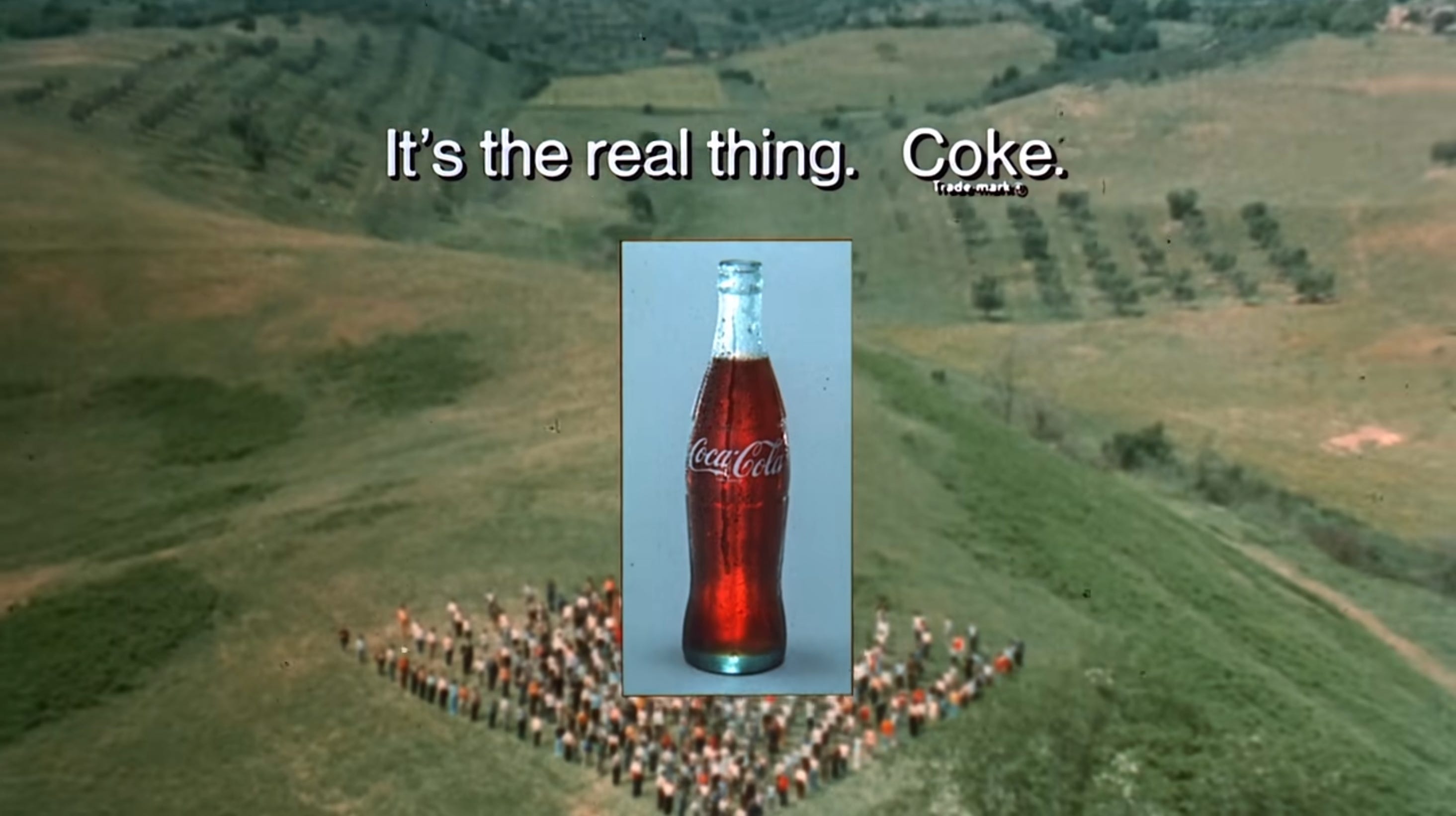
In 1969, Coca-Cola launched a now iconic campaign: “It’s the Real Thing.” The goal back then was the same as today: position yourself as authentic when trust is cracking everywhere. Vietnam, the Civil Rights fight, the rise of broadcast TV, a fractured country. In 1971, they paired it with the utopic hilltop ad, “I’d Like to Buy the World a Coke,” casting the beverage as a unifier of a divided world.
It worked, but it was still a marketing construct. As Coke’s brand manager said at the time, it was a direction that “responds to research which shows that young people seek the real, the original and the natural as an escape from phoniness.”
That could have been written today. Realness is what people ask for when belief collapses.
A decade ago, Mad Men used this ad to close out the series. Don Draper, the man forever in search of meaning, meditating on the California coast, having an epiphany cutting to the iconic “It’s the real thing” ad. But he hasn’t had some transformation. He’s just commodifying his earlier trip across America, taking realness and distilling it into an ad for the moment.
This is the trap Draper spent seven seasons caught in. He was able to sell authenticity to everyone except himself. He could manufacture meaning on demand, but never locate his own. Not because he wasn’t talented or even sensitive — he was both. But he never could turn inward. He kept looking for the answer in the next pitch, the next woman, the next reinvention. He had no interior life to draw from, so everything he made was borrowed.
Coke could sell “the real thing” because no one expected a soda to deliver on an existential promise. The distance between the marketing and the product was the whole point. Startups don’t get that distance. At the early stage, the founder is the product. Your investors, your first ten employees, your first hundred customers — they’re all close enough to feel the gap between what you say you believe and what you actually do. The marketing has to be the truth, or it’s nothing.
So if realness can’t be claimed and craft can (and will) be copied, what’s left? The only thing that can’t be replicated: the specific thing you believe and the visible proof that you’re living it. That is real.
It’s hard to find online. The algorithm is powerful. The feed is loud. The onslaught of people telling you what to think, what to build, how to present yourself — it will drown out any signal you have. Many of the people who seem “plugged in” are mouthpieces of the moment, championing the Current Thing, with little sense of what they actually believe. They are like Draper. They don’t have their own principles and can’t help you find yours.
You have to turn inward before you can project outward. This applies to people. It applies to startups.
Here is what I think that requires:
You need an internal compass. Not a mission statement, not a positioning exercise — a sense of what you care about that doesn’t shift when the discourse or heat shifts. Something specific enough that you can feel when you’re drifting from it. It takes time. It’s developed from a lot of different (and sometimes conflicting) inputs and then tuned on your own beliefs. The work is interior. It happens before you have anything to show for it.
You need to let your choices prove it. Where you spend your time, how you spend your money, what you say no to — these communicate more than any brand voice or founder narrative. The founders I trust most have a visible consistency between what they say and what they do
You need to resist performing the process. The temptation is to narrate the journey — the “building in public” reflex, the vulnerability posts, the authenticity signaling. But the real work of developing conviction is slow and boring. It starts humble and personal, not bombastic or cult-like. It builds from simple origins and then earns the audience.
Startups are belief machines. Belief in the real thing before it is there. Early valuations are belief. Early hiring is belief. Early customers are belief. Realness in startups has always been a shared conviction that becomes true because enough people act as if it is — and then follow through to make it so.
You can tell when certain companies and people have it. A small group of people with no distance between themselves and the vision. Driven by hope more than proof. But there is confidence they will get there. They create a collective spirit and soul that others latch onto in spite of facts. Then the “cult” is created.
Before you worry about how you come across, before you think about cutting through: figure out what you actually believe. What you’d still be building if there were no scoreboard. It’s slow, and it’s thankless in the short term. But over time, that becomes magnetic. It brings others along.
That’s how the real thing gets made.
Good one. Love how you’re managed to combine some current cultural analysis with some incisive Prestige TV–era criticism. Bravo!